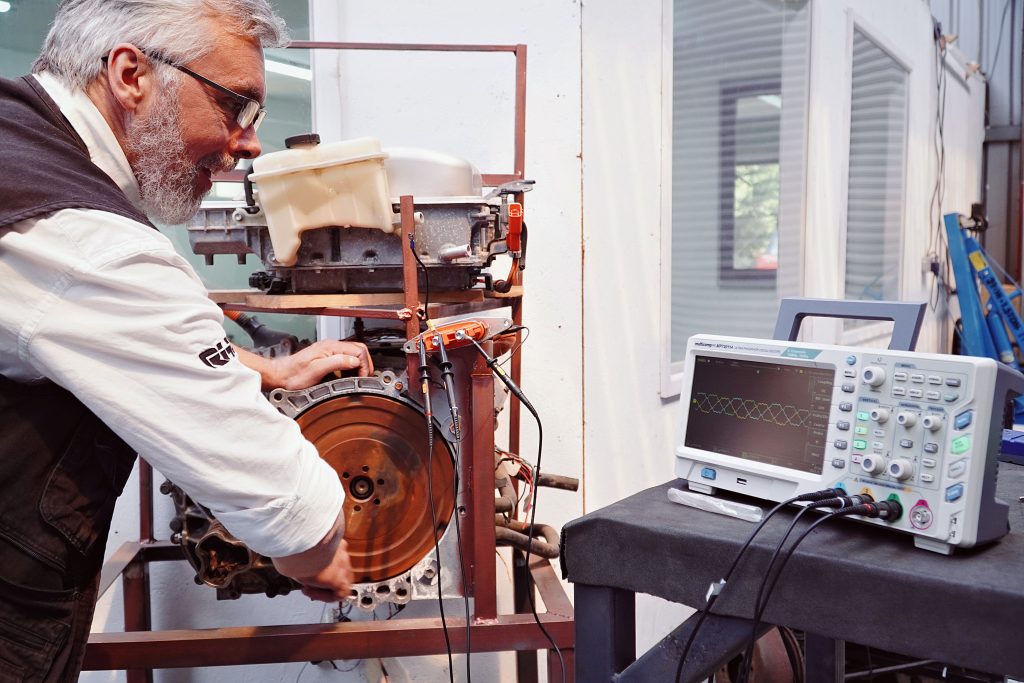
The engine- throbbing heart of the car, and it gives the car soul too. But how many of us really know anything about it?
The basics of how your engine work are fairly simple, but modern engines have little details that would scramble the brains of Einstein. Luckily I will gloss over them and keep it simple!
Basic principal.
Mix fuel with air and set fire to it, it goes bang and expands damn fast. Now that’s fine for pyro effects in films but doesn’t push a car along. The engine converts the explosion energy into a twisting motion that can eventually drive the wheels using some fairly simple mechanics.
It works by keeping the explosions in cylinders, usually about the size of beer cans. The top of the cylinder is sealed with the cylinder head which has valves in to let air in, and some more to let exhaust gas out. The other end of the cylinder has a piston in which is pushed down by the exploding gas.
Now if that was all there was then the explosion would just launch the piston into the ground like a badly aimed cannon ball, so the piston is connected to some mechanical links, which as it turns out are exactly like the ones on a bicycle. No, really they are. When you pedal a bike, your legs move up and down, imagine your knee is the piston and your lower leg is the
connecting rod (con rod) which moves the pedals which are on a simple crank, and that’s how up and down is turned in to round and round. Two pedals on a bike are like two cylinders of an engine, engines with more cylinders just use a longer crank with more pedals on.
All that lot needs to be held in place by something pretty solid, this big lump of metal is called the engine block. Some engines separate this into two bits, the cylinders in a cylinder block and the crank in a crank case. The bottom end with the crank in is sealed off underneath with a glorified bucket called a sump, which catches all the oil running out of all the well lubricated rotating parts.
Valves.
Each cylinder needs a valve to let air in from the intake system, and another one to let the burnt gas out into the exhaust system. The valves are usually like the stem of a wine glass, or a penny on a stick if your not posh. The cylinder head has holes cast through it to let gas pass, called ports. The valves are stuffed into the ports so that the valve head blocks the port off at the cylinder end. Pushing the stick part of the valve down lifts the valve head off the valve seat in the cylinder head so that the gas can pass. It only lifts a few mm so the shape of the valve seat makes a big difference to how much flow there is, and so power. Its these little details that the really good tuners sort out.
Stroke.
The valves have to be opened and closed at just the right point in the cycle, a four stroke engine opens the intake valve so that as the piston moves down it drags air and fuel mix into the cylinder, that’s the first piston stroke. Then the intake valve is shut and the piston comes back up on the second stroke, squashing the mixture. If you compare the size of the mixture at the bottom of the stroke to how small it is at the top of the stroke you usually find that its been compressed by roughly ten times, this is the compression ratio. The compressed mixture is set fire to near the top of the stroke, which forces the piston back down on its third stroke which is the one stroke that makes any power and pushes the car along, all the other strokes actually use power. Then when that’s done the exhaust valve opens and the piston comes back up, the fourth stroke, pushing the exhaust gas out. Then it all starts again, at full chat it might repeat 100 times a second.
Cams.
So what makes the valves go up and down then? That’d be the cam shaft, its a long stick with lumps on, its located above the valves (usually) and spun round in sync with the crank and pistons so that the lumps hit the top of the valve stems and force them open at just the right moment. The valve then returns shut again because it has a very stiff valve spring pushing it shut, unless its a ‘Desmo’ engine, but that’s another storey for another time!
The cam is designed to open and close the valves to give the right performance, its a complex subject but the design of the came lobe shape has a massive effect on how well the engine breaths and is one of the top tuning parts.
There are loads of variations on this theme, most modern engines double up on valves and have two for intake and two for exhaust in each cylinder, just to get more gas flow and power. Many use two cam shafts (twin cam), one for all the inlet valves and another one for the exhaust valves.
Cams don’t directly touch the valves, the follower reduces friction and can be either a steel disk, called a shim, which sits in a little bucket, or sometimes there is a little lever, called a rocker, and sometimes its a little hydraulic cylinder, called a tappet, which is pumped up with oil so that it automatically sets just the right valve clearance, which is crucial to getting good performance and reliability. This clearance has to be great enough that when the valve is shut it sits hard against its seat, otherwise there is a chance high pressure hot exhaust will be pushed through and burn the seat out. But if the clearance is to large then the valve won’t fully open and it will make a clattering sound as the lobe hits the follower with a thump, which can be damaging.
The cams are driven by either a chain or a toothed belt that is driven by the crank, which has to go round twice for the pistons to do the four strokes, so the cams are driven at half the speed of the crank y having a drive pulley twice as big as the one on the crank .
The cam and crank pulleys are usually linked by a belt or chain which is aligned so that the cam opens the valves at just the right moment, this is cam timing. If the valve opens too soon or too late then less gas is pumped through the engine and power drops, and if the timing is way out the valve might hit the piston at the top of the stroke and that means big engine damage. Adjustable Vernier pulleys are available to fine tune the timing on race engines.
Oil
To keep all the rotating parts moving freely, oil is pumped through little tunnels or galleries in the block and head which feed the crank, con rod, cams and valve stems. The oil pump is usually driven off either the crank or the cam and has a pressure regulator and an oil filter to ensure a steady and clean supply of oil. Using the right oil makes a difference to power and reliability.
Stay cool.
The explosions generate a hell of a lot of heat, in fact its enough to melt the engine. So coolant, usually an equal mix of glycol and water flows through hollow passages around the cylinders and cylinder head, especially round the valve seats, to let the coolant take the heat away to the radiator. The whole lot is pumped round fairly slowly by the coolant (water) pump.
So there it is, an engine. Simple in principal but tricky in the details.